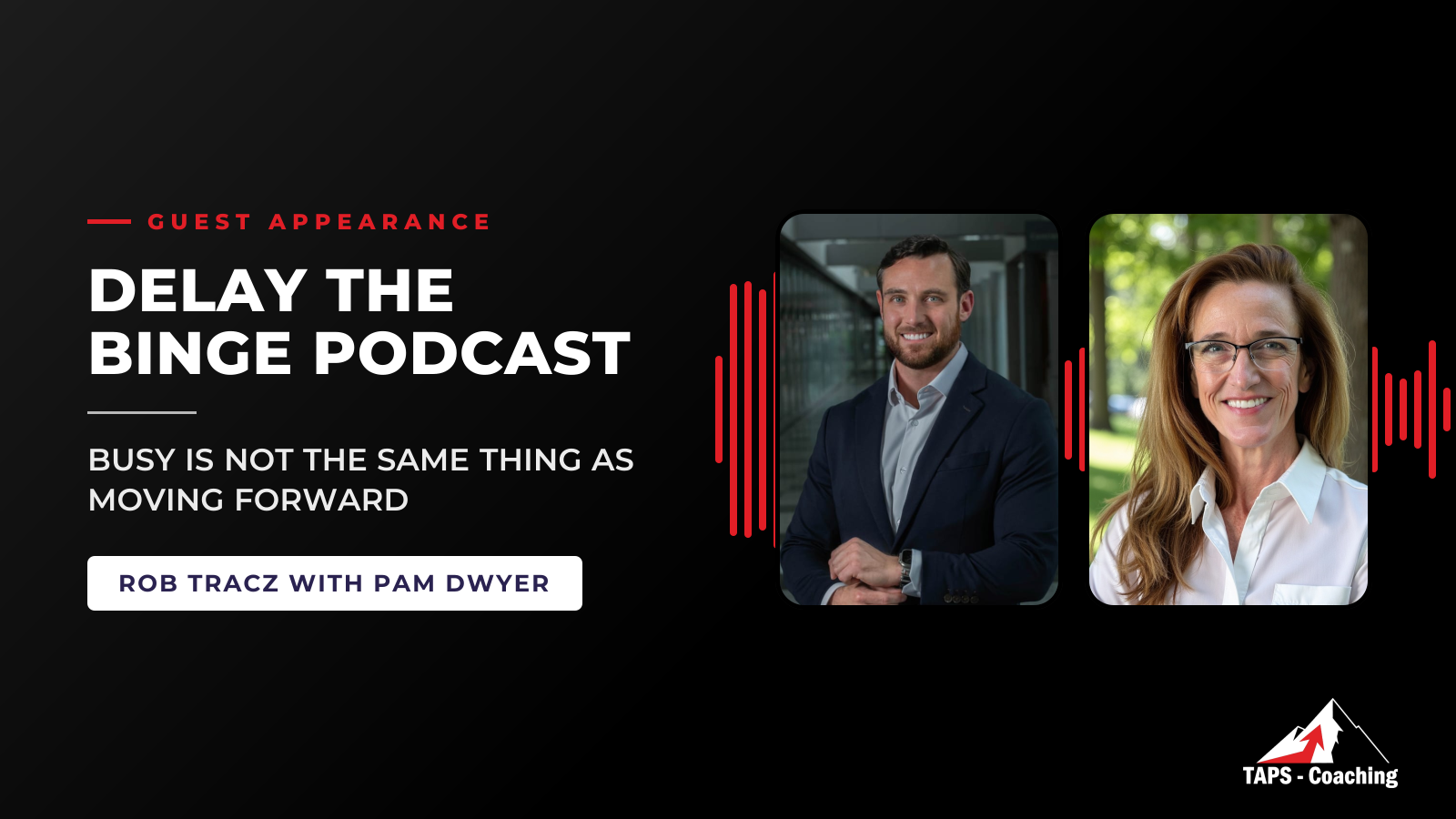
There is a moment in my conversation with Pam Dwyer on Delay the Binge Podcast that stopped me cold. Pam asked me a simple question: has learning to slow down ever been harder for you than learning to work hard?
And I just sat with it for a second, because the honest answer is yes. Absolutely yes. And I did not expect to feel that so clearly when she asked.
You can find the full episode on Delay the Binge Podcast if you want to hear the full conversation, but I want to write about it here because what Pam pulled out of me that day was worth a longer look.
The default setting nobody questions
Here is what I told her. I learned to outwork people at such an early age that grinding just became my default setting. It worked, too. It worked in sports. It worked in school, 4.0 GPA through a master's program. It worked in the early days of entrepreneurship. So I kept doing it because the evidence said it was right.
The problem is that a default setting does not care about context. It just runs.
So when my dad got sick with pancreatic cancer, I told myself I was going to make more time to go see him. But I never really made that time. And when he passed, instead of processing any of it, I went back to the only thing I knew how to do. I went back to work. Another year of grinding before I finally broke down and ran out of gas entirely.
The lesson I pulled from all of that is not that hard work is bad. It is that hard work without awareness is just noise dressed up as progress.
What Pam calls quiet depletion
Pam has a term I want you to hold onto: quiet depletion. It is when everything on the outside looks like success. You are checking the boxes, hitting the milestones, doing all the things. But on the inside, you are running on fumes and the habits carrying you forward stopped serving you a long time ago.
I recognized it immediately because that was exactly what I was living. The relationship fell apart. Friends stopped calling, and then they stopped inviting me because I always said no. I missed holidays, birthdays, Christmas, Thanksgiving, all of it. Those were all red flags, but they were not bright enough to cut through the tunnel vision I had built around myself.
That is what I now call robot mode. Efficient, locked in, zero awareness of anything outside the goal. And the issue is not robot mode itself. Sometimes you need it. The issue is not being able to flip back out of it.
Being busy and making progress are not the same thing
Pam said this near the close of our conversation and I thought it was worth writing out plainly, because it is easy to agree with and hard to actually believe when you are in the middle of a sprint.
Being busy feels like progress. It has the same texture. It occupies the same hours. It produces the same tired feeling at the end of the day. But when I finally slowed down enough to reflect, genuinely reflect, I realized I had been making noise. I had been checking boxes that were not moving me anywhere I actually wanted to go.
Reflection is the thing that breaks that apart. Not overthinking. Not ruminating. Just creating enough space to ask: am I moving, or am I spinning?
One of my mentors told me something I reference all the time now. He said, just figure out what works best for you and try your best to do those things. Don't beat yourself up if you can't get to them all.
That advice sounds simple. It is actually radical if your identity is built around outperforming a checklist.
Emotional agility is the real skill
What I have come to believe, and what I shared with Pam, is that the goal is not to eliminate the hard-driving version of yourself. That version has real value. It built real things. The goal is flexibility, being able to step into that mode when the situation calls for it, and then step back out into something more human, more present, more aware.
One of my mentors teaches social agility, how to read a room, how to navigate different contexts and power dynamics. I think the same principle applies internally. Call it emotional agility. You need to be able to flip the switch and then flip it back. The people who struggle most are the ones who can only flip it one direction.
The pattern interrupt that actually works
Pam asked me what one small thing a person could do this week if they realize they have been moving too fast. My answer was not complicated.
Pause. Create a pattern interrupt. Thirty seconds, a minute, whatever you can actually carve out. Sit in it. Let your brain disconnect. Then, from that quieter place, take one honest look at where you are going and whether the next step you were about to take is the right one.
You do not need a new system before you do this. You just need to stop long enough to actually see what is happening.
That is what awareness looks like in practice. Not a morning routine you bought from a guru. Not a 90-day optimization plan. Just pausing long enough to notice, and then paying attention to what actually works for you.
Your next step
If this conversation is landing for you, I want to invite you to do something concrete. I built the Prime Performance Process around six principles: Resilience, Intentionality, Clarity, Optimization, Influence, and Opportunity. Each one addresses a specific place where capable people get stuck.
If you want to know where your biggest leverage point is right now, take the free assessment at /assess. It takes about five minutes and it will show you which principle deserves your attention first, so you are not just adding more to the pile. You are working on the right thing.
“Hard work without awareness is just noise dressed up as progress.”
“The issue is not robot mode itself. The issue is not being able to flip back out of it.”
“Pause. Sit in it. Let your brain disconnect. Then take one honest look at whether the next step is the right one.”
From the podcast
This came from a conversation on Delay the Binge Podcast.
Hosted by Pam Dwyer
Listen to the full conversation.