Keep doing what got you here. If a certain level of effort won you championships, carried you through school, and built your first business from nothing, the smart move is to keep bringing that same effort and trust it to take you to the next level. For a long stretch of my career, that was the advice I would have given you without blinking, and it was the advice I lived by.
So I worked seven days a week. I pushed through holidays and birthdays. Two weeks without a day off became two months, and two months quietly became two years. The business was doing fine on paper, and I was stuck on a hamster wheel, losing clients and gaining clients, grinding full speed and going nowhere.
That advice works right up until the day it stops working, and nobody tells you which day that will be.
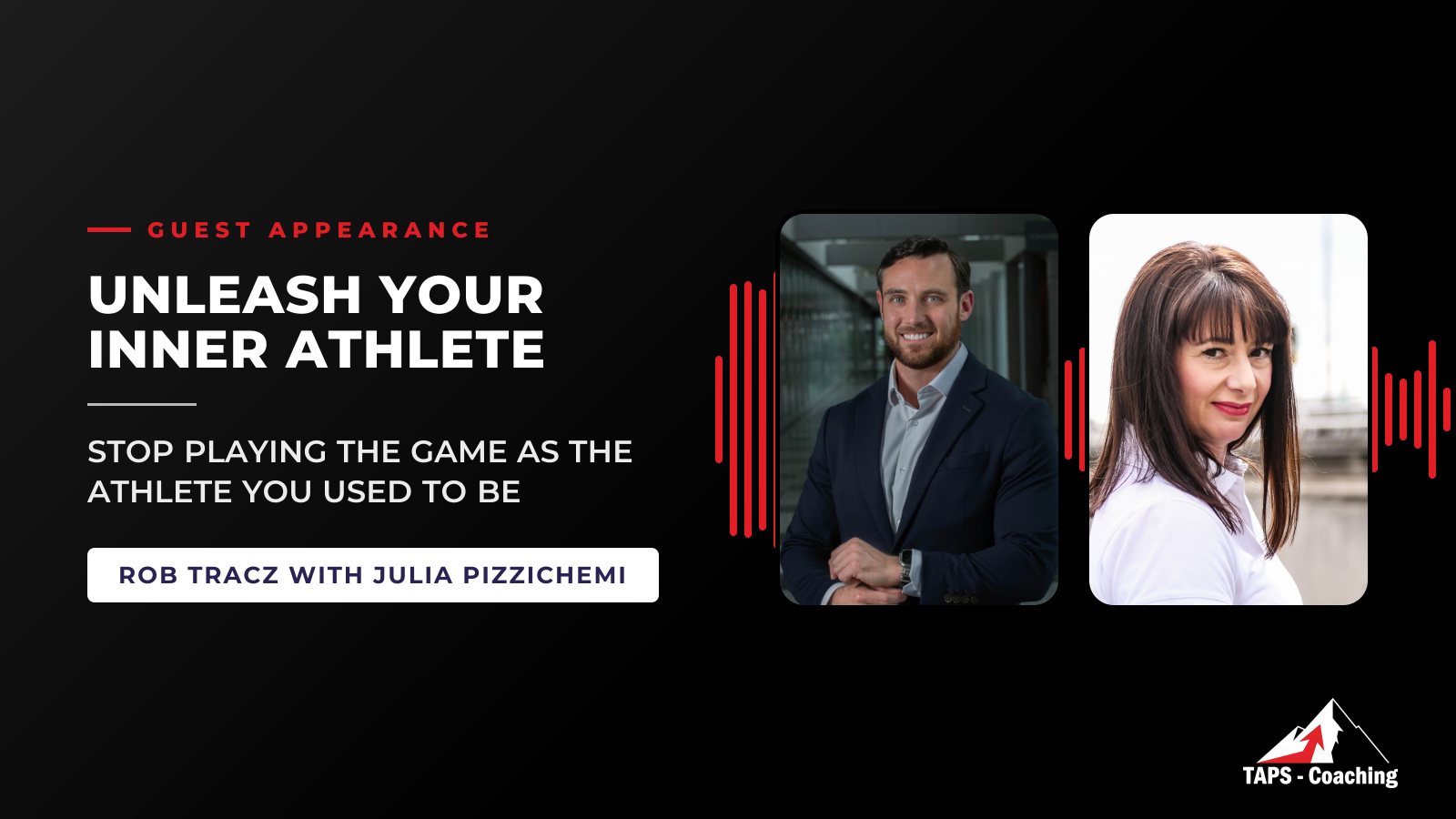
I got to dig into this with Julia Pizzichemi on her show, Unleash Your Inner Athlete, and I loved the conversation. Julia has spent decades in elite health and fitness, she lived her own version of those 4:30 a.m. starts and midnight finishes, and she asks the kind of questions that pull you past the polished answer. You can hear the full thing /here when it goes live, and here is what I took away from it.
Sloppy passes on a brand new team
After I lost my dad, I knew I wanted to pivot what I was building, and I also knew I needed to get out and be around people again. Rugby made sense. I played in college, I was a leader on a championship team, and I figured I was in good enough shape to jump right back in.
My first game back was rough. New team, a position I had never played, a little older than most of the guys, and my passes were sloppy, my tackles were weak, and I was constantly out of position. I kept asking myself why I was so bad at something I used to be great at.
Somewhere in there, maybe after a hit that knocked some sense into me, it landed. Stop playing the game as college Rob. Start playing the game as current Rob. Figure out where this version of me needs to stand so the team can win.
That one shift carried straight into my business. When I started building as the future version of myself, instead of defending the old one, the direction got clear and the shiny objects started falling away.
Julia's question about our younger selves
This is where Julia took it somewhere I had not expected. She asked whether this is a common thread, that we keep trying to progress through our business and our health as the person we were at 20 or 30, when energy came easy and everything felt natural.
I would say yes, and it is one of the biggest reasons people stay plateaued. Your habits, beliefs, values and goals got you to exactly where you are now. When you set a bigger goal without adjusting any of those, you just chase it and never get closer.
It works the same way in the gym. Your body is a perfect reflection of how you have been eating, moving and sleeping. If you want more energy or a different look, you have to start doing what those people do. For me, on the business side, that meant getting better at speaking, getting more comfortable connecting with people, and learning the technology that comes with coaching calls and podcasting. None of that was in college Rob's toolkit. Current Rob needed all of it.
Put bookends on every season
Later in the episode, Julia described approaching business like an athlete's training year. You have an in-season and an off-season. You pick a goal, you consume what helps you get there, and once that season passes you step back and reorganize before the next one.
I stopped her there, because she had said something special and we had almost rushed right past it. When that season ends.
That was the piece I missed for years. I was just pushing to the next financial milestone, then the next, then the next, and I never put an ending on anything. Without an ending, you never get a chance to look back. You live in one long season that never finishes, and that is how effort turns into burnout.
When you define the season you are in and give it a deadline, you create room to reflect. Was this season a success? What do I need to do more of next time? What do I need to do less of?
Bookends also make letting go easier. Julia pointed out how hard it is to step back from something you have poured effort into and genuinely enjoy. Setting something aside for a designated season is a pause with a return date. When the season closes, you reevaluate, and maybe that project is a perfect fit for the next one.
I had to do this with podcasting. I was in a season of growth, and recording on Monday, then Wednesday, then Friday had me switching from strategist to presenter to host all week. Every hat swap costs a little energy. So I contained podcasting to one day a week, and suddenly my other projects got my full attention again.
Consumption has a season too
One more turn in this conversation surprised me, because it pushes back on advice I used to follow hard. When I first made the shift out of strength and conditioning, I cut out TV, music and social media, and filled every spare minute with research, audiobooks, podcasts and courses. Great inputs, all of them.
The problem was I left no room to create. When you are in full consumption mode, nothing gets built, and that slowed my progress more than any distraction ever had. This is the heart of what I call intentionality in the Prime Performance Process: matching your inputs to the season you are actually in. Some seasons call for filling the tank. Others call for shutting the books and getting to work.
Review your film before the next season starts
Athletes watch film after the season for a reason. They are looking for what the current version of them did well, and where they were still playing out of an old habit.
So here is your question, and give it more than a passing thought:
What season is your business in right now, and when does it end?
If you cannot name the season, that tells you something. If you can name it but there is no end date, that tells you something too. And if the answer you reach for sounds like the person you were five or ten years ago, take note of that.
At the end of our chat, Julia asked what one thing I wanted listeners to walk away with. My answer was simple. Pause, reflect, and decide. Create a small pattern interrupt in your day, even thirty seconds, sit with where you are, and let the next step show itself.
If you want some structure around that pause, I put together a free 4-day training at /training. Think of it as your end-of-season film session: four short days to see where you are running on old habits, close out the season you are in, and plan the next one as the person you are now.
“Stop playing the game as the person you used to be. Start playing it as the person you are now.”
“Without an ending, you never get a chance to look back. That is how effort turns into burnout.”
“Setting something aside for a designated season is a pause with a return date.”