Finishing my morning routine at 4 p.m.
Back when I was running my strength and conditioning business, I worked 15, 16, sometimes 17 hour days, seven days a week, and I was proud of it. I'd look at people taking Saturday and Sunday off and think, why? Those are two perfectly good production days.
So once I got into personal development and every guru out there told me a successful life starts with a successful morning, I went all in. I'd wake up at 3 or 4 a.m., take a cold shower, meditate, journal, practice my Spanish, go for a walk to get some sunlight, stretch, drink more water, and keep stacking. And by the time I checked off the last box, it was 4 p.m. My morning routine had quietly become my morning and afternoon routine, and I was too exhausted to do any of the work that actually grew the business.
Pretty impressive checklist. Very little traction.
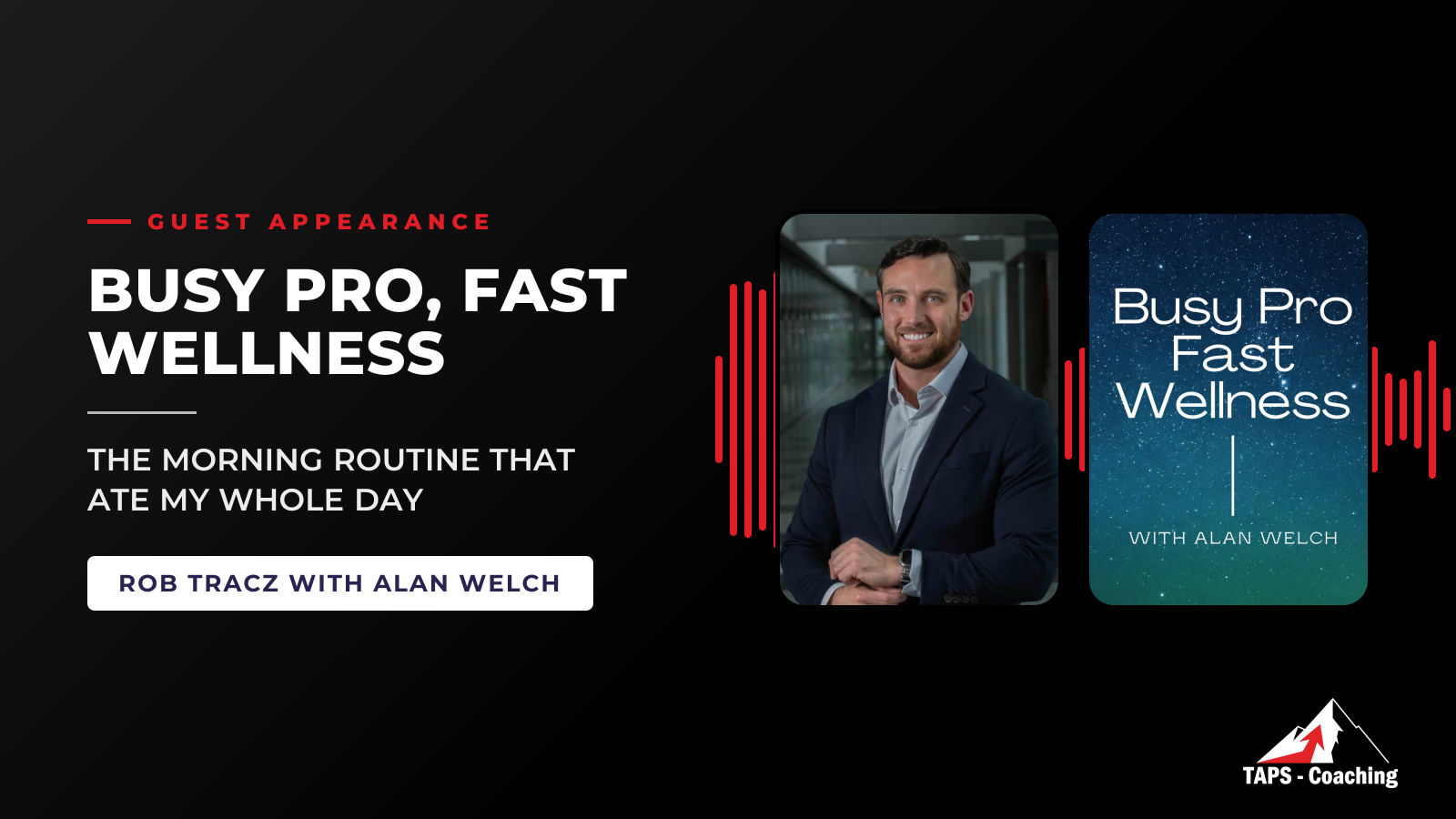
When Alan Welch had me on his show, Busy Pro, Fast Wellness, he opened right on those years of 15 hour days and asked a question I loved: how can someone tell whether their hard work is moving them forward or keeping them stuck? It's a great question for you specifically, because if you're reading this, grinding is probably part of who you are. It was part of who I was too.
A hundred miles an hour down the wrong road
So here's what that motion does. It feels good day to day. You're busy, you're tired, you're checking boxes, and that feels like progress. Alan brought up what I call the paradox of optimization, where you're ticking everything off the list and still not getting anywhere in particular.
Think about a road trip where you never look at the map. You keep your foot on the gas, you add more speed, and eventually you pull your head up to see where you are, only to find out you've been going a hundred miles an hour down the wrong road. And now the cost to turn around is huge, way bigger than if you had slowed down earlier, looked at the signs, and made an informed decision. That gap between where you are and where you meant to be is where a lot of burnout and frustration comes from.
Alan pushed further. What about the person who knows exactly what matters but just has too much on their plate? My answer was the cheesiest, simplest advice I've got: slow down.
None of us want to hear it. Take a day off and it feels like you're falling behind, so you go double time to catch up. Then a sick day or an emergency pulls you away and you go double time again. Every time, you add more friction to yourself. And the funny part is that most of the time you already know what you need to be doing. The fires and the urgency are what keep you from doing it.
The turn, a pile of conflicting certifications
Alan had picked up on a line of mine, slow is smooth and smooth is fast, and he asked what the right pace actually looks like for someone whose business depends on them.
My honest answer is that everybody's pace is their own. Early in my coaching career I went to every certification course and workshop I could find. One expert said you had to use kettlebells. Another said dumbbells. I absorbed all these philosophies and they fought each other in my head. What changed things was building my own identity as a coach. Once I knew who I was, I could pick the pieces I liked, test them with my clients, and double down on what worked.
That was the turn for my business too. Guru advice can be good advice for some people. Your job is to take it in, run it through your own situation, and keep what fits your vehicle.
PACE, the four gauges on your dashboard
I'm a big acronym guy, so I turned pace itself into one.
- P is priorities. Run every item on your list through three filters: how important is it, how urgent is it, and how significant is it for you and your business long term. Score each one and whatever comes out highest goes first.
- A is automate and delegate. The lower scoring items go here. AI, a virtual assistant, or eventually a team of your own.
- C is cut or contain distractions. Notifications, social media, somebody else's problem. Some things get cut completely, and some get boxed into certain time periods.
- E is evaluate and adjust. Set a deadline to test the plan, then ask whether the priorities have changed and what needs to shift.
That last letter is where I see people stall. They say, this got me to my first 100K, so I'm not changing anything. The strategy that got you here was the right fuel for that leg of the trip. The next leg probably needs some adjustments.
This is what the Optimization principle in my Prime Performance Process is really about. Tuning the engine you already have so the hours you're putting in go somewhere.
What the rapid fire round added
Alan closed with four quick ones, and my answers fit in your pocket:
Warning sign you're moving fast in the wrong direction: isolation. I was around clients all day and felt more alone than ever.
Stop measuring the outcome outright and start measuring the process, the actions it takes to get there. When the day starts running you, create a pattern interrupt, even thirty seconds to pause and breathe before your next step. And the one small action that makes tomorrow easier is reflection.
Score tomorrow's list tonight
So here's your move for the next 24 hours. Tonight, before bed, write out tomorrow's list and score every item on the three P filters: important, urgent, significant long term. Circle the top one. Then take a minute to reflect on how today went and what you're excited about tomorrow. That little bit of reflection gets your mind working on tomorrow while you sleep, so you wake up already pointed down the right road.
Alan and I cover more of this, including the story of my dad and how it changed the way I spend my time, in the full episode on Busy Pro, Fast Wellness. Thank you, Alan, for such a thoughtful conversation.
And if you want to check which gauge on your dashboard is reading low before you hit the gas again, take the free 6-Principle assessment. It's a quick look under the hood so your next stretch of hard work actually moves you somewhere.
“My morning routine had quietly become my morning and afternoon routine, and I was too exhausted to do the work that grew the business.”
“Most of the time you already know what you need to be doing. The fires and the urgency are what keep you from doing it.”
“Stop measuring the outcome outright and start measuring the process, the actions it takes to get there.”
From the podcast
This came from a conversation on Busy Pro, Fast Wellness.
Hosted by Alan Welch
Listen to the full conversation.